 |
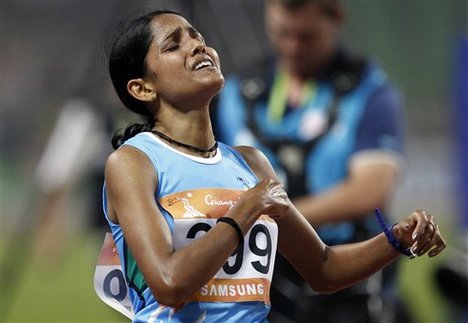
| Preeja at the finish |

 |
That evening as I settled down to watch the first day of athletics events on television, two young Indian girls stepped on to the tracks. The 60,000 strong crowd of mostly Chinese roared for the local favorites as the women set off in quest of the 10,000 m gold.
The tiny looking Indian girls gamely held on to the leading bunch lap after lap giving a glimmer of hope. The two athletes - Preeja Sreedharan and Kavita Raut - were not the favorites to win. Kavita had won a bronze at the Commonwealth Games in the same event while Preeja disappointed. As the track official sounded the bell for the last lap, the Indian girls took off, as if from a sling shot, leaving others in their wake. Never before had I seen anything like this.
The girls made it look so easy from distance. Preeja and Kavita, who finished first and second, even jogged a victory lap.
While Indian fans ( I don’t even know if there are many) lap up the achievements of the Indian women, what many may not know is that both these athletes had won a bigger battle to get to the Asian Games arena. Both of them had to beat poverty and its associated hurdles to win laurels for our country.
Preeja's father died when she was very young and her older brother dropped out of school to become a carpenter's apprentice. Her mother worked in neighbors’ homes to feed the family. Preeja caught the eye of her athletics coach while in school in Kerala's Idukki district. Due to her athletic prowess, she got help to finish her degree and a job with the Railways followed.
With the Rs10 lakhs won by Preeja at the Chennai marathon in 2008, the family has bought a small plot of land in Palghat where they are building a house.
Kavita's story is no different.
She belongs to a poor family in the adivasi belt of Trimapkeswar near Nasik. She has four brothers and says she chose running as it could be done barefooted and without spending any money. Kavita is now employed with Oil and Natural Gas Corporation.
I was waiting anxiously for their return to the tracks for the 5000 m race today. Preeja looked confident. She was the smallest of the lot and the least assuming. It was charm to see her in sprint. There was a rare grace in her movements. She appeared an angel on wings.
The close-up shots showed a very different and distressing part of the competition. It is not an easy game. The amount of stress, effort,fear and anxiety on their faces brought tears to my eyes. They put every iota of energy left in them in to their feet. I was relieved when I saw Preeja winning the race. Kavita won the bronze.
And just a short while after this, our girls won the 400 m relay race as well.
When time permits try to have a look at the finishing moments of an athletics sprint . You will find all emotions possible on those faces. It is simply not easy at all. I wouldn’t dare to compare it with any other event.
It is a reward less field with not much of accolades or glory. And for that matter, not even money or stardom. They don’t get invited to the parties of film stars or politicians, and are soon forgotten.
Cricket is the national obsession in India. Its stars dominate the headlines and devour almost all the sponsorship deals. All other games and sports are submerged under this game, if you can call it so. Historically, the government offered little help to the athletes, and corporations were reluctant to sponsor those who competed in obscure sports. This reality lead many athletes to a common destination: jobs with the Indian railway or police. Most of the women athletes finally settle down with any ordinary job to make their livelihood. It is not surprising that we do not produce as many men athletes as women.
India, which ranks behind only China in population with more than 1.1 billion people, could never get a gold medal in Olympics, till Bindra won it at the air rifle shooting competition at the Beijing Olympics.
 |
| Preeja Sreedharan with the gold medal |
This prompts an ever-persistent question. Why do we continually fail to produce elite athletes on the international stage? We are getting recognition as a growing economy. But is that just enough?


